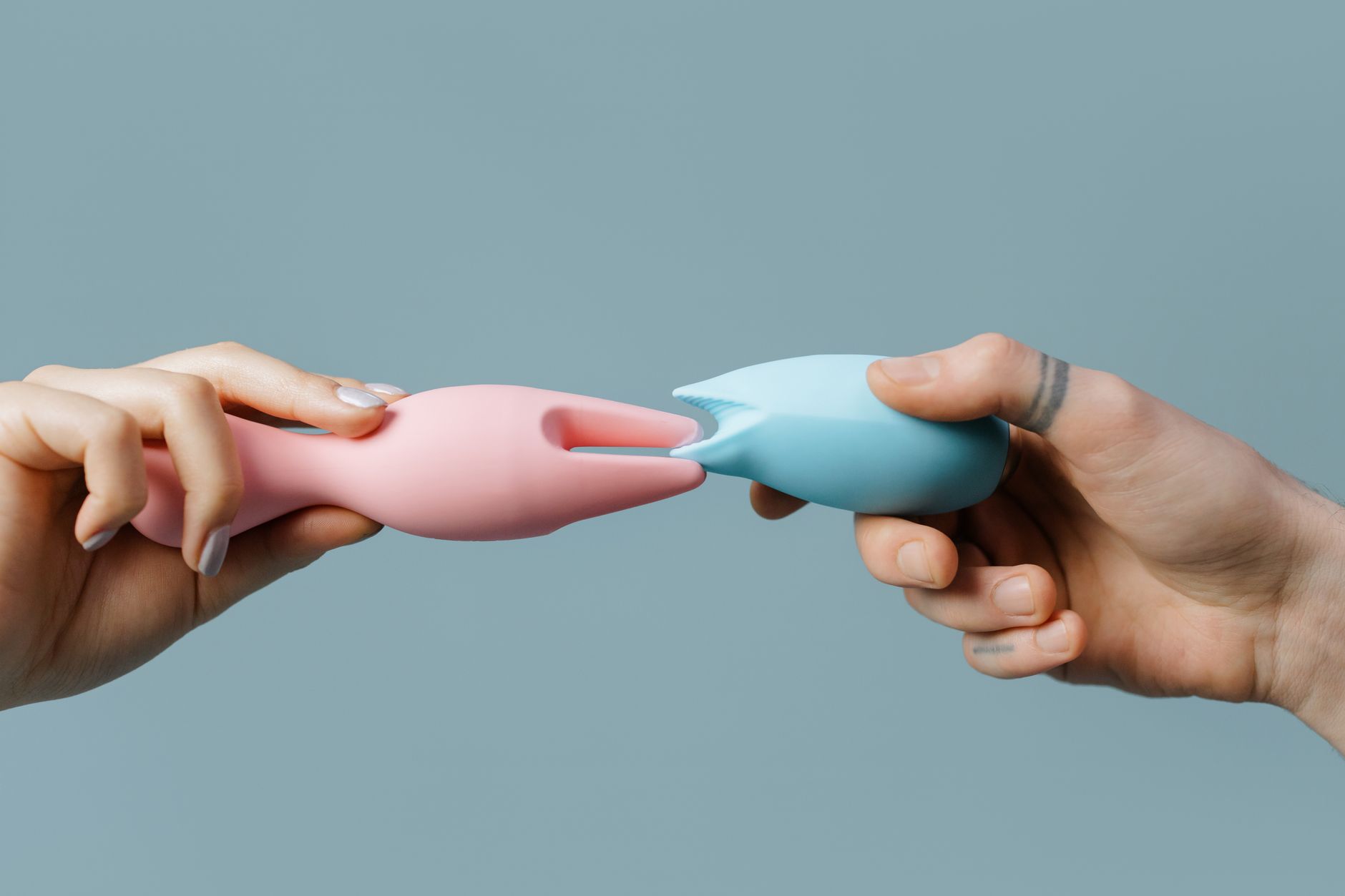
How to Use Lemon Vibrators When Pleasure Peaks Unpredictably With Hormones
Your arousal isn't broken. It's just following a schedule your brain didn't forward you. Here's how to work with your hormones instead of fighting them.
Your body isn't messing with you. But your hormones absolutely are. Estrogen, progesterone, and testosterone all cycle through your system in a pattern your rational brain may have completely forgotten about by week three. The result: some days, touch feels electric. Other days, the same touch feels like nothing. Neither version is wrong. Both are biochemistry.
Here's the simplified version: estrogen peaks around ovulation, which means better blood flow to the vulva, faster arousal response, and easier orgasms. Progesterone rises after ovulation and often dampens sensation. Testosterone dips at certain points in the cycle for people with ovaries, which directly affects desire. Add in life stress, relationship shifts, or age-related changes, and your arousal can feel genuinely unpredictable.
But here's what research actually shows. Inconsistent pleasure isn't a sign something's wrong. It's a sign your body is doing exactly what it's supposed to do. The problem is that we've been taught to expect a flat, steady baseline. That's not how any of this works.
Most people don't track their cycle in relation to sexual response. They just notice one month they can orgasm in five minutes and the next month it takes thirty. Then they assume one of those versions is the real them. Spoiler: both are.
Why I recommend lemon clitoral vibrators specifically for hormone-driven variability comes down to pattern flexibility. Unlike traditional vibrators that rely on friction, lemon vibrators use gentle suction stimulation. This matters when your sensitivity is in flux.
When estrogen is high and your tissue is plumped with blood, suction feels amazing. When progesterone peaks and sensation dulls, the same device feels gentler and more manageable because you're not dealing with direct pressure. You're not fighting your body into a one-speed experience.
I've worked with clients who used to think they "broke" during their luteal phase. Once they switched to suction-based tools, they realized they hadn't broken. They'd just been using the wrong approach at the wrong time.
You don't need a fertility app or obsessive charting. You need three months of loose data.
When you masturbate or have partnered sex, jot down the date and a one-word note: easy, medium, tough, or no-go. Notice if there's a pattern. Most people find that days 10-14 of their cycle (if they have a regular cycle) are peak arousal windows. Days 19-25 often feel duller. Days 1-5 vary wildly depending on the person.
If you don't have a cycle anymore due to age, hormonal birth control, or other reasons, the pattern might be about stress, sleep, or relationship timing instead. Track those variables. You're looking for your own map, not a generic one.
When arousal is fast and sensation is sharp, start with the lowest setting. Suction devices have an intensity range that lets you match what your body's actually asking for instead of what you think you should handle.
Many people make the mistake of cranking it up on their peak arousal days because the sensation feels dull at lower intensities. What actually helps: take your time. Long warm-up. Low intensity first. Let sensation build gradually. You'll often find that by the time you're properly aroused, even mid-range feels intense. Your body was just waiting.
On unpredictably good days, when you weren't sure if pleasure would show up and it did, resist the urge to rush. That's when your nervous system is being especially cooperative. Extend it. Your pattern next cycle will thank you.
This is where most people get frustrated and give up. You've got a day when touch feels muted or almost numb. The instinct is to push harder, faster, stronger. That usually backfires and leaves you feeling more disconnected.
With a lemon vibrator, start at a higher setting than you'd normally use. Suction is gentler than vibration at equivalent power levels, so the intensity is less jarring. Give yourself at least 20-25 minutes. Arousal takes longer to build when progesterone is high or estrogen has dipped. That's not a failure. That's biology.
If sensation still feels distant on these days, switch approaches. Sometimes partnered touch, a different type of stimulation, or even just stopping and coming back tomorrow is the right call. Your body is telling you something.
Here's where the emotional part matters as much as the physical part. If you've got a partner, they need to know that your arousal variability isn't about them. It's also not about your desire for them (though sometimes it feels that way). When you're in your low-sensation phase and sex feels like obligation, your partner might interpret that as disconnection. It's not. It's neurobiology.
The fix: communicate the pattern explicitly. "Around this time in my cycle, my body takes longer to warm up. It's not about you. It's predictable. Here's what helps." Then actually use that knowledge. If you know days 20-24 are slower, that's when you schedule longer foreplay, use your lemon vibrator proactively, or pivot to touch that doesn't need to result in orgasm.
When both of you understand the pattern, you stop treating variations like failures. You start treating them like data.
Sometimes you chart, you try everything, and there's still no predictable cycle. This happens with stress, certain medications, hormonal birth control, or life transitions. You're not broken. You're just not cycling in a visible pattern.
In this case, the lemon vibrator becomes your flexibility tool. Because response is unpredictable, you need a device that matches multiple versions of you. Suction-based stimulation works when sensitivity is high and when it's low. It works whether arousal takes five minutes or fifty. You're not forcing your body into one setting. You're following where it wants to go.
On truly random days, I often recommend people use their lemon vibrator more as an exploration tool than a goal tool. Not "I'm using this to have an orgasm." More like "I'm using this to see what my body's in the mood for today." Sometimes that leads to orgasm. Sometimes it leads to relaxation. Both are valid.
Your partner might be consistently high-arousal and you might be predictably variable. Or vice versa. Or you might both be all over the map. The goal isn't to get on the same schedule (you usually can't). It's to stop treating the mismatch like a problem.
When only one person in the relationship has variable arousal, the non-variable person often feels rejected or second-guessed. The variable person feels pressured to be "on" when they're naturally "off." A lemon vibrator helps because it gives you a way to participate in pleasure together without either of you having to wait for the other's natural rhythm to align. You use the device together on the days when that works. On harder days, you have a tool that bridges the gap.
Countintuitively, some people find that mid-cycle arousal actually requires less direct stimulation than they thought. When sensation is heightened, lower settings feel more intense. When you're used to scrolling through high settings during your luteal phase, you show up mid-cycle and dial it up out of habit. Then sensation becomes overwhelming.
This is where the real benefit of variable-intensity lemon vibrators shows up. You can dial down without switching devices. You can learn that your "normal" during low-sensitivity days is actually too much for your high-sensitivity days. Once you know that, pleasure shifts from feeling erratic to feeling responsive.
Hormone fluctuations directly affect blood flow to your genitals, tissue thickness, lubrication, and neurotransmitter levels that affect desire. Estrogen peaks around ovulation, which enhances arousal. Progesterone rises after ovulation and often dampens it. This isn't random. It's a pattern that repeats unless you're on hormonal birth control, past menopause, or experiencing other hormonal changes. Some variation is normal for everyone, but people with ovaries typically see more dramatic shifts.
Yes, but differently. Hormonal birth control suppresses your natural hormone cycle, so you won't see the peaks and troughs. Instead, you'll have a flatter baseline. A lemon vibrator's gentleness can help because it doesn't require you to already be highly aroused to feel something. Start low and explore without pressure. If arousal is still completely absent, that might be a medication conversation with your doctor rather than a vibrator conversation.
Chart for two or three cycles. If you see a pattern that repeats roughly every 28 days, it's likely hormonal. If the variation seems totally random or connected to stress, sleep, or relationship dynamics, you might have overlapping factors. Most people have both. The pattern is there, but life stress can override it. The good news: whether it's purely hormonal or a mix, the tracking and device flexibility approach still works.
No. If anything, the opposite. Using a tool that meets your body where it actually is prevents the frustration cycle where you feel broken because you're not responding "normally." Accepting variation is healthier than fighting it. The vibrator isn't creating dependence on high stimulation. It's letting you work with your actual physiology instead of the physiology you think you should have.
This is really common and worth naming explicitly. Your partner might be frustrated that some days you're into it and other days you're not. You might feel guilty that your body doesn't cooperate on their timeline. The fix is understanding that partnered pleasure doesn't require synchronized timing. You can use a lemon vibrator together on your low-sensitivity days without it feeling like you're substituting for real connection. You're actually solving for two different bodies with different timing.
Partially. You can use them to make the experience more pleasurable while arousal builds slowly. But you can't generally force fast arousal on a slow day. What you can do: set realistic timelines. If your low-sensation days need 30 minutes instead of 10, build that into your expectations. Use the vibrator as part of a longer warm-up rather than as a quick fix. Accepting the timeline is often more satisfying than fighting it.
Consistency in pleasure doesn't come from forcing your body to respond the same way every day. It comes from understanding how your body actually works and building practices around that understanding.
When you know your pattern, a lemon vibrator becomes less of a luxury and more of a literacy tool. It's helping you read what your body is asking for. Some days that's intensity. Other days it's gentleness. Neither version is broken. Both are you.
If you're navigating hormonal changes and want to understand your pleasure better, how to use lemon vibrators when estrogen fluctuations affect arousal goes deeper into the science side. And if the unpredictability is affecting your relationship, we've got practical strategies there too.
Your body is not your enemy. It's just on its own schedule.